Recycling and Sustainability for House Cleaners: A Practical, Local Approach
 House Cleaners and home-cleaning teams increasingly play a vital role in reducing waste and cutting carbon emissions across neighborhoods. Our sustainability statement explains how residential cleaning crews, house-cleaning services, and independent home cleaners work together with borough services and local partners to improve recycling, donate reusable goods and run a low-emission fleet. We set measurable goals so every visit contributes to a greener city.
Our Recycling Percentage Target and Timeline
We aim for a 70% recycling rate across all operations by 2030. That target covers materials captured from client homes, packaging from cleaning products, and end-of-life items collected during clear-outs. The target is ambitious but achievable when combined with staff training, route consolidation, and collaboration with municipal waste services. Progress is tracked quarterly so we can report improvements and recalibrate tactics as needed.
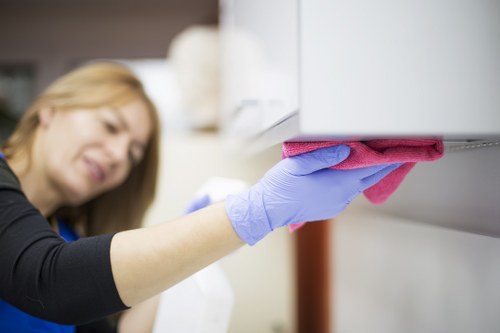
![A person wearing a black long-sleeved top and blue disposable gloves is using a pink cloth to clean the underside of a grey kitchen cabinet or cupboard. The person is holding a white spray bottle in their other hand, aimed at the surface to assist in cleaning. The cabinet has a smooth, matte finish, and is situated above a white countertop or work surface. The scene takes place in a modern kitchen with bright, natural lighting, emphasizing a tidy and well-maintained environment. The focus is on the detailed cleaning action, illustrating professional care for kitchen surfaces, which aligns with the services offered by House Cleaners in the UK, including sustainable cleaning practices in the [POSTCODE] or [TOWN].](/pub/_photos/cleaning/f3383932776.jpg)
Working with Local Transfer Stations
We rely on the network of local transfer stations and consolidation depots to ensure collected recyclables are processed correctly. Rather than sending mixed loads directly to landfill, teams drop sorted streams ??? paper, mixed containers, glass, and food waste ??? at authorized transfer facilities. In many boroughs this aligns with council collection practices where residents separate glass, paper, plastic and food caddies at source. By matching borough sorting rules we reduce contamination and help the municipal system meet its own recycling targets.Partnerships with charities are a core element of our circular approach. Rather than disposing of gently used household items found during deep cleans or decluttering sessions, our teams identify reusable goods and redirect them to partner charities and social enterprises. Soft furnishings, small furniture and working appliances are assessed on-site; acceptable items are bagged, catalogued and taken to charity collection points or repair workshops. This prevents usable items from becoming waste and supports community reuse programs.
 Low-carbon vans and fleet strategy are central to reducing operational emissions. Our fleet strategy uses a mix of electric vans for urban rounds, hybrids for mixed routes, and route-optimization software to minimize mileage. Charging is prioritized at depots and public rapid chargers where available. By switching to low-emission vehicles and refining schedules, we reduce per-job CO2 emissions and improve air quality in densely populated areas. We expect a fleet-wide emissions reduction of 40???60% compared to conventional diesel vans within five years.
To make recycling practical for clients and crews we follow the boroughs' preferred waste separation models and offer standard practices across service areas. Typical recycling activity includes:
- Paper and card ??? flattened and kept dry for municipal collection or transfer station loads.
- Mixed containers ??? rinsed plastics, cans and cartons bundled for the correct stream.
- Glass ??? segregated in dedicated boxes to avoid breakage and contamination.
- Food waste ??? small caddies used where boroughs operate food-collection services.
- WEEE and batteries ??? separated and delivered to authorized take-back points or transfer stations.
Sustainability is embedded in daily operations beyond recycling. We prioritize concentrated, biodegradable cleaning products and refill systems to reduce single-use plastic. Training ensures teams know how to capture recyclable streams during declutters and regular cleans, and staff carry multi-compartment bags to keep materials separated. Energy efficiency at depots ??? LED lighting, smart thermostats and equipment maintenance ??? further lowers the carbon footprint of our house cleaning services.
![A young woman with dark, wavy hair and a friendly smile is standing in a well-lit indoor space, holding a spray bottle of cleaning solution in her right hand and a yellow sponge in her left hand. She is wearing a light grey long-sleeve shirt and bright blue rubber cleaning gloves, indicating she is engaged in cleaning tasks. The background features a plain, neutral-colored wall with soft natural lighting, creating a professional yet approachable atmosphere. The woman appears to be preparing for or actively involved in cleaning a residential or commercial environment, aligning with professional cleaning services offered by House Cleaners. Her attentive stance and clean appearance suggest a focus on maintaining high standards of cleanliness, relevant to a site dedicated to eco-friendly and sustainable cleaning practices in the UK, particularly around areas like [TOWN] or [POSTCODE]. This image emphasizes the importance of effective cleaning tools and environmentally conscious methods associated with the services provided by House Cleaners at housecleaners.org.uk, within the relevant service category of cleaning, linked to sustainability initiatives in UK homes and workplaces.](/pub/_photos/cleaning/f3383885824.jpg) Our community engagement strategy emphasizes the circular economy. Where items need repair, we work with local repair caf??s and social workshops to restore rather than discard. Where charities cannot accept certain items, we direct them to reuse exchanges or municipal reprocessing centers to keep materials in circulation. These partnerships strengthen local networks and ensure that reusable goods benefit people in need rather than occupying landfill space.
Our community engagement strategy emphasizes the circular economy. Where items need repair, we work with local repair caf??s and social workshops to restore rather than discard. Where charities cannot accept certain items, we direct them to reuse exchanges or municipal reprocessing centers to keep materials in circulation. These partnerships strengthen local networks and ensure that reusable goods benefit people in need rather than occupying landfill space.
 In summary, this sustainability program for residential cleaning teams blends measurable targets, practical on-the-ground recycling activity, collaboration with transfer stations and charities, and a transition to low-carbon vans. Whether you refer to us as House Cleaners, home cleaners or house-cleaning services, our approach is the same: reduce waste, donate where possible, and cut emissions. We continually refine operations to reflect borough-specific recycling rules and the evolving recycling infrastructure. Together with municipal partners and community organizations, we???re turning routine cleaning visits into opportunities for lasting environmental benefit.